
How IoT Is Transforming Environmental Monitoring
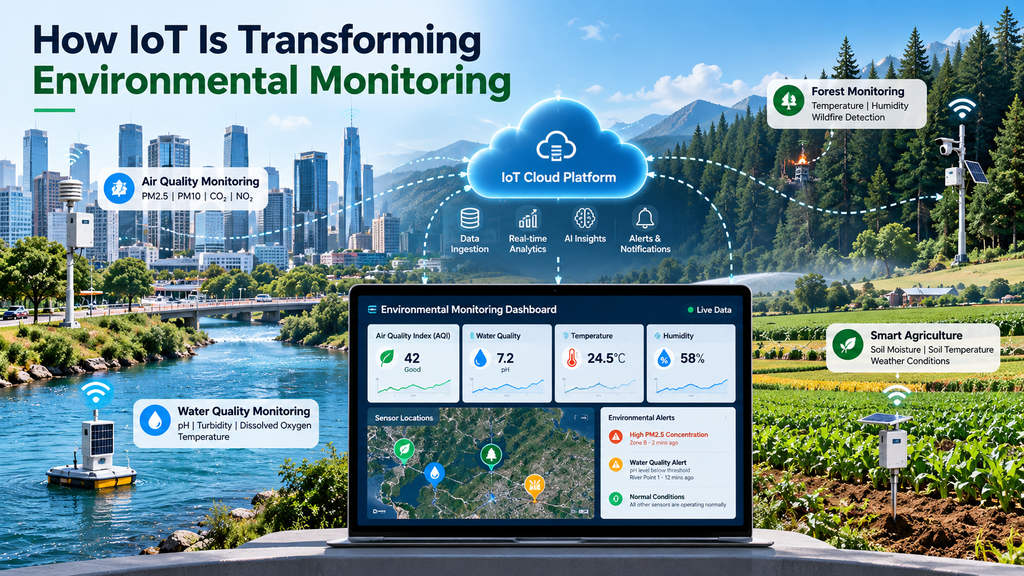
Environmental conditions influence public health, ecosystems, agriculture, and industrial operations. Monitoring these conditions accurately is essential for understanding environmental changes and making informed decisions.
Traditional environmental monitoring often relies on periodic measurements and manual data collection. Although these methods remain useful in many situations, they may not provide the continuous visibility needed to understand rapidly changing conditions.
The Internet of Things (IoT) is helping transform this process by connecting sensors, communication networks, and software platforms. These technologies make it possible to collect environmental data more frequently, monitor conditions remotely, and identify changes that may require attention.
In this article, we explore how IoT is changing environmental monitoring and where connected monitoring systems can make a difference.
What Is IoT-Based Environmental Monitoring?
IoT-based environmental monitoring uses connected devices and sensors to measure environmental parameters and transmit the collected information to a software platform for viewing and analysis.
Depending on the application and sensor configuration, these systems can monitor parameters such as:
- Air quality, including particulate matter and selected gases
- Water quality parameters such as pH, temperature, and dissolved oxygen
- Soil moisture and temperature
- Rainfall and weather conditions
- Water levels and potential flood conditions
The exact parameters available depend on the sensors, instruments, communication technology, and monitoring system being used.
By connecting these measurements to a centralized platform, organizations can access environmental information without having to collect every reading manually.
How Does IoT Environmental Monitoring Work?
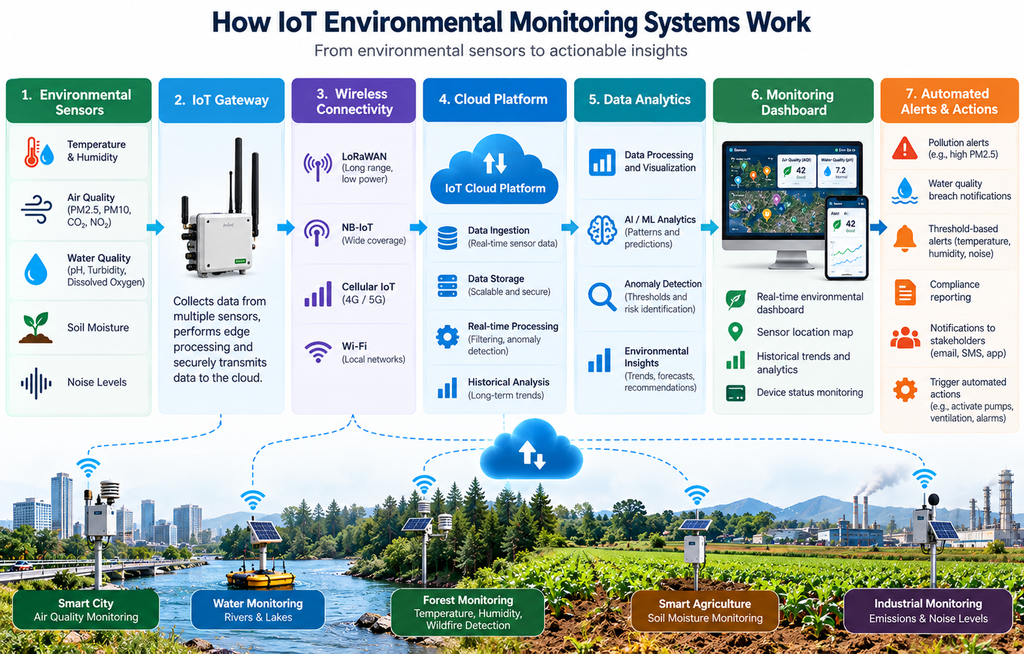
An IoT monitoring system typically involves four main components.
1. Sensors and Monitoring Devices
Sensors measure specific environmental parameters at the monitoring location. These devices may be installed in cities, industrial facilities, agricultural fields, water bodies, or other locations where environmental information is needed.
The quality and usefulness of the resulting data depend on appropriate sensor selection, installation, calibration, and maintenance.
2. Data Transmission
The collected readings are transmitted to a central system using a suitable communication method. Depending on the deployment, this may involve cellular networks, Wi-Fi, LoRa-based connectivity, or other communication technologies.
The choice depends on factors such as network availability, transmission distance, power requirements, and the amount of data being sent.
3. Data Processing and Visualization
A monitoring platform receives and organizes the measurements. Users can view available information through dashboards, charts, maps, and historical records.
This helps make sensor readings easier to understand and compare over time.
4. Alerts and Informed Decisions
Where supported, monitoring systems can generate alerts when configured thresholds or conditions are met. These notifications can help responsible teams investigate changes and decide whether further action is needed.
Alerts support decision-making, but they do not replace appropriate investigation, verification, or professional judgment.
Key Applications of IoT in Environmental Monitoring
Air Quality Monitoring
Air quality monitoring helps organizations understand the levels of selected airborne pollutants in a particular location.
Connected air quality monitoring systems can collect readings at configured intervals and make the information available through dashboards. This can support environmental assessments, trend analysis, and public awareness.
For cities and industries, accessible air quality data can help identify patterns and inform decisions about further investigation or mitigation.
Water Quality Monitoring
Water quality is important for drinking-water management, industrial processes, agriculture, and aquatic ecosystems.
Connected monitoring instruments can measure selected parameters, such as pH, temperature, dissolved oxygen, or other application-specific indicators.
Continuous or frequent monitoring can help users observe changes more quickly than occasional manual measurements alone. The appropriate parameters depend on the water body, intended use, and applicable monitoring requirements.
Precision Agriculture
Agriculture increasingly uses sensor data to understand field conditions.
IoT-based soil monitoring can provide information about parameters such as soil moisture and temperature. When combined with suitable farming practices, this information can help farmers assess irrigation needs and understand variations in field conditions.
The usefulness of these systems depends on sensor placement, crop requirements, local conditions, and how the collected data is interpreted.
Weather and Flood Monitoring
Connected weather stations, rain gauges, and water-level sensors can provide measurements from locations that may be difficult to monitor manually.
When supported by reliable communication and appropriate alert configurations, these systems can help responsible teams observe rainfall, water-level changes, and other relevant conditions.
Such monitoring can support preparedness and situational awareness, although it does not guarantee accurate flood prediction or eliminate the need for established warning procedures.
Benefits of IoT-Based Environmental Monitoring
More Frequent Data Collection
Automated monitoring can collect readings at regular intervals, providing a more detailed view of changing environmental conditions than occasional measurements alone.
Remote Accessibility
Authorized users can access data remotely when the monitoring devices, communication network, and platform support it. This can reduce the need to visit every monitoring location simply to retrieve readings.
Better Visibility Across Locations
A centralized platform can bring data from multiple connected devices into one place. This can help teams compare locations and understand broader patterns.
Faster Identification of Changes
Dashboards, historical trends, and configured alerts can help users notice unusual readings or changes that warrant investigation.
Improved Data-Informed Planning
Historical environmental data can help organizations evaluate trends, review operational decisions, and plan future monitoring activities.
These benefits depend on reliable equipment, suitable connectivity, accurate measurements, and effective data management.
Challenges to Consider
IoT environmental monitoring also involves practical challenges.
Sensor accuracy and calibration: Sensors require appropriate selection, calibration, maintenance, and validation to ensure that measurements remain useful.
Connectivity limitations: Remote locations may have limited network coverage, so communication methods must suit the deployment environment.
Power and maintenance: Devices installed outdoors or in remote locations may require careful power planning and periodic servicing.
Data security: Connected systems should use appropriate authentication, access controls, secure communications, and software maintenance.
Data interpretation: Measurements need context. Environmental conditions, sensor limitations, and measurement uncertainty should be considered before drawing conclusions.
Planning for these challenges from the beginning helps create more reliable monitoring systems.
The Role of Integrated IoT Platforms
Collecting sensor readings is only one part of environmental monitoring. Organizations also need ways to view, organize, and interpret the information.
An integrated IoT platform can bring device data, dashboards, historical records, and supported alerting functions together. This can make it easier for teams to work with information from different monitoring locations.
Alcodex develops Envitus, an IoT platform associated with environmental monitoring applications. The platform and connected monitoring solutions are intended to help organizations work with environmental data across relevant use cases.
The appropriate solution depends on the monitoring objective, required parameters, deployment conditions, and system requirements.
Looking Ahead
As connected devices and data platforms continue to evolve, IoT will remain an important part of environmental monitoring. Better access to timely measurements can help organizations understand environmental conditions and make more informed decisions.
However, effective monitoring requires more than installing sensors. It depends on reliable measurements, appropriate communication, well-managed data, regular maintenance, and the ability to translate information into useful action.
By combining suitable monitoring equipment with connected software platforms, organizations can build a clearer picture of environmental conditions and respond more effectively to the information available to them.
Conclusion
IoT is transforming environmental monitoring by connecting sensors, data transmission, visualization, and alerting into more integrated systems. Applications across air quality, water quality, agriculture, weather, and flood monitoring demonstrate how connected measurements can support environmental awareness and planning.
For organizations exploring these technologies, the starting point is to identify the environmental parameters they need to monitor and select a solution suited to their operational requirements.
Interested in environmental monitoring and IoT solutions? Explore the Alcodex product range to learn more about Envitus and connected monitoring applications.
